
The All-on-Full™ Surgical Protocol: Anatomy, Positioning and Geometry of Force
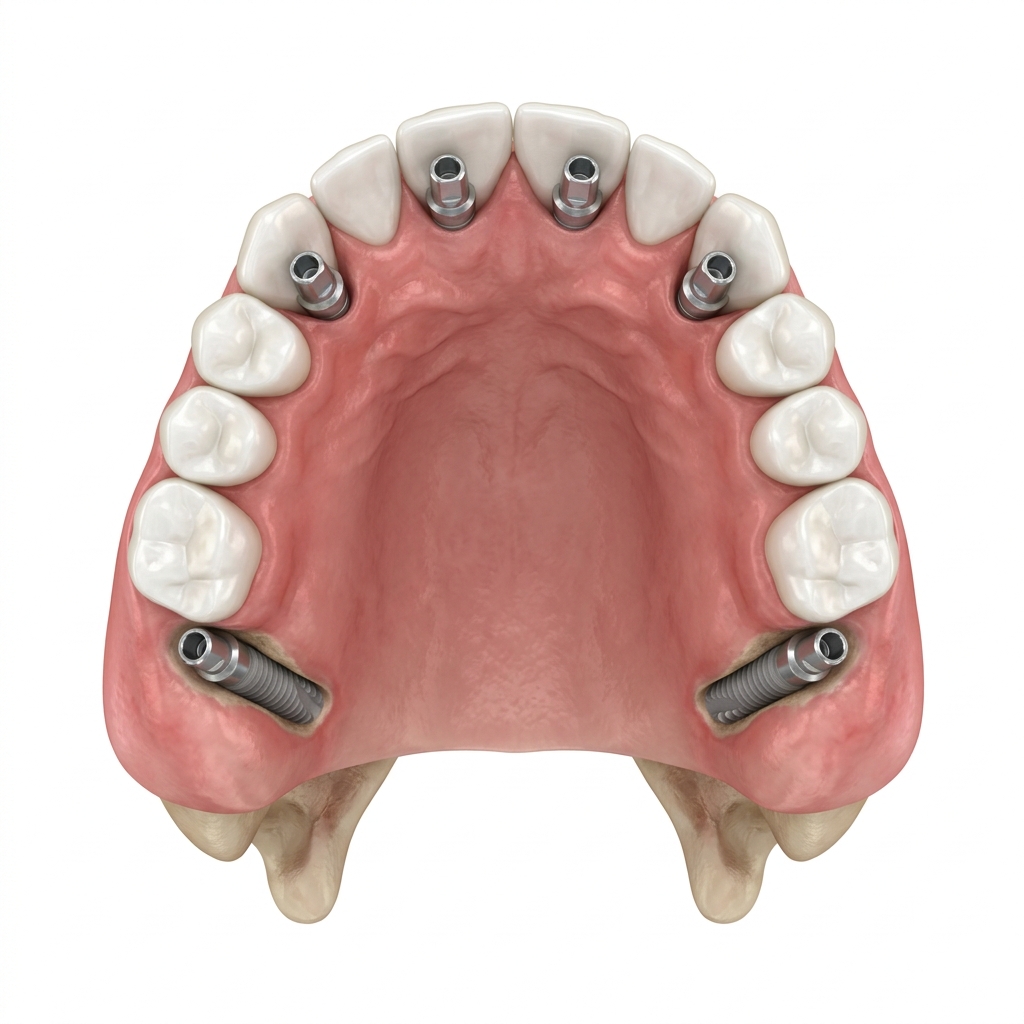
All-on-Full™ is not a simple prosthesis on implants, but a surgical, anatomical and biomechanical protocol of the highest precision. It is the definitive evolution matured in the field to overcome the structural limits and failures of the All-on-4 and All-on-6 systems: anchorage in the deep basal bone and pterygoid, 14 real ceramic teeth with all molars and zero fake gum.
Here is how it is composed and where exactly the implants are positioned in the All-on-Full™ surgical protocol.
Rehabilitated with the All-on-Full™ protocol
Rehabilitated with the All-on-Full™ protocol
The real videos: the failures and how we solved them
Two real cases, two failures — All-on-4 and All-on-6 — solved with the All-on-Full™ protocol.
All-on-6 failure: the patient calls Nicola and solves in 1 hour
Failed All-on-6 solved
The patient calls Nicola Lettera: fixed teeth in 1 hour. +39 388 7527525.
The All-on-4 failure and the All-on-Full™ solution
All-on-4 failure (1/3)
The failure and how we solved it.
All-on-4 failure (2/3)
The solution: All-on-Full™.
All-on-4 failure (3/3)
The result: all molars, without fake gum.
1. The Biomechanical Leap: From Sand to Rock
The historical limit (All-on-4 / All-on-6): the old systems anchor the implants in the alveolar bone — a spongy and unstable tissue, the same one that periodontitis has destroyed and that continues to resorb over time. It is like planting stakes in the sand: the collapse comes sooner or later, and with it the failures we see every day in our practices.
The All-on-Full™ turning point: the technique moves entirely onto the basal bone, cortical and deep. It anchors directly on the rock, a non-resorbable tissue, immune to pyorrhea, which guarantees lifelong stability. The difference between the two philosophies is abysmal: from sand to rock, precisely.
Without bone, avoid sinus lifts and in 2 hours with the All-on-Full™ technique solve the molars without gum (click to play)
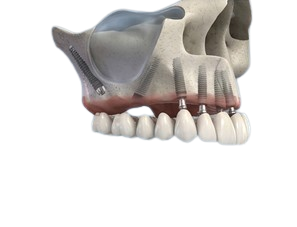
2. The Surgical Map: Where the Implants Go
The All-on-Full™ geometry is based on strategic pillars that reinforce the maxillary arch, creating a perfect and natural force distribution.
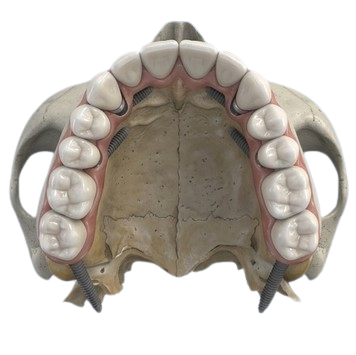
A. The Posterior Pillars: The True Basal Pterygoid (Sites 18 and 28)
They are the true engine and the secret of the longevity of the protocol:
- Positioning: dedicated implants with very high load capacity (19 mm or 21 mm long, with a 4.5 mm diameter) are placed in the deep pterygoid region.
- Anatomy: the implant crosses the soft tuber, intersects the palatine bone and the sphenoid, and engages as much as 1 cm in the cortical plates of the sphenoid (pure cranial bone).
- Performance: they develop a truly extraordinary insertion torque (up to 150 Ncm) and offer a cranial-type anchorage. They fully support the molar chewing, discharging the forces far from the anterior areas.
B. The Anterior Pillars: The Retrocanine Fossae and the Reinforcement Sites (Sites 15 and 25)
- Positioning: the retrocanine fossae are used, areas of extreme hardness and bone density (evolutionary remnant of the canines of predators) that guarantee a perfect antero-lateral basal anchorage.
- Function: they complete the stability quadrilateral together with the posterior pillars, distributing the masticatory loads over the whole arch and protecting the premaxilla.
C. The Premaxilla: The Cutting and Shield Area
- Positioning: in the anterior area (from canine to canine) no heavy or high vertical load chewing is imposed.
- Function: the anterior implants (selected to measure based on the clinical case, such as nasal/sub-nasal implants, split crest or targeted screws) serve exclusively for the premaxilla to cut, tear, grasp and support the lip: the aesthetic and incisal function, without biomechanical stress.
3. Clinical and Functional Advantages of the All-on-Full™ Protocol
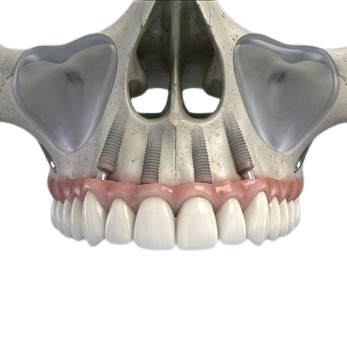
- 14 Real Ceramic Teeth (Zero Fake Gum): thanks to the stability of the basal pillars, the prosthetic architecture returns a complete arch of 14 natural ceramic teeth, without the bulk of "fake" plastic gum profiles.
- Perfect Hygiene and Peri-implantitis Prevention: the absence of fake gum and dead spaces eliminates the pockets where food infiltrates. No residue, no pus, zero chronic inflammation and goodbye to the risk of peri-implantitis.
- Occlusion and Global Health: an optimal load distribution and the presence of all posterior molars allow chewing any food efficiently, protecting the musculature, the temporomandibular joint (TMJ) and preventing digestive disorders.
- Psychological Protection and Well-being: definitively solving the pyorrhea in a single structured path returns immediate confidence and self-esteem, sweeping away the anxiety and social depression linked to removable dentures and compromised smiles.
4. The Prosthesis: Circolare d'Autore®
This is our registered dental prosthesis Circolare d'Autore®: 14 teeth, all molars, without gum — the definitive prosthesis that completes the rehabilitation. Discover all the details →