Nasal and Sub-Nasal Implants
Transverse nasal implants
Transverse nasal implants are implants placed in the mid-anterior area of the upper jaw (sites 15 and 25) that laterally bypass the maxillary sinus using the dense bone of the retrocanine fossae. They allow stabilising the premaxillary area, creating intermediate support between the frontal and posterior areas and evenly distributing the masticatory loads on the arch.
Transverse nasal implants are implants placed in the mid-anterior area of the upper jaw, corresponding to sites 15 and 25 (first and second premolar). They are inserted with a trajectory that laterally bypasses the maxillary sinus, using the dense bone of the retrocanine fossae (D1 quality).
These implants allow:
- Bypassing the maxillary sinus laterally, without manipulating it
- Stabilising the premaxillary area, creating intermediate support between the frontal and posterior areas
- Distributing the masticatory loads evenly on the arch
Sub-nasal implants
Sub-nasal implants are placed in the frontal area of the maxilla (sites 4/6) under the nasal fossae, in the hard palate, a particularly dense bone region (D1-D2 quality). They offer excellent primary stability for immediate loading, optimal support for the frontal prosthesis and can be placed with a transmucosal technique without incisions or sutures.
Sub-nasal implants are placed in the frontal area of the maxilla (sites 4/6, incisors and canines), under the nasal fossae, in the hard palate. This bone region is particularly dense and stable, ideal for guaranteeing a secure anchorage in the anterior area.
Characteristics of sub-nasal implants:
- Placed in D1-D2 quality bone
- Excellent primary stability for immediate loading
- Optimal support for the frontal prosthesis
- Can be placed with a transmucosal technique
Role in the BSS configuration
In the Bilateral Sinus Solution™ (BSS), the transverse nasal and sub-nasal implants work in synergy with the posterior pterygoid implants according to a three-level architecture: pterygoid for the molars (18/28) — the only implants properly definable as basal —, transverse nasal for the premolars (15/25) placed in the dense bone of the retrocanine fossae, and sub-nasal or blade for the frontal area (4/6). This optimal load distribution allows 14 teeth without fake gum.
In the Bilateral Sinus Solution™ (BSS), the transverse nasal and sub-nasal implants play a complementary role with respect to the posterior pterygoid implants:
- Posterior area (18/28): pterygoid implants for molar support
- Mid-anterior area (15/25): transverse nasal implants for premolar support
- Frontal area (4/6): sub-nasal implants or blade implants for anterior support
This three-level architecture allows an optimal distribution of the masticatory loads over the whole arch, making possible the rehabilitation with 14 teeth and a zirconia-ceramic prosthesis without fake gum. For the detailed insertion procedure, see the Surgical Procedure page.
Differences with pterygoid implants
Nasal and sub-nasal implants differ from pterygoid ones in: insertion area (mid-anterior vs posterior), anchorage (nasal basal bone/hard palate vs tuber+sphenoid), length (10-15 mm vs 19-21 mm), inclination (variable vs 45-60 degrees) and supported teeth (premolars, incisors, canines vs molars). Pterygoid implants offer bicortical anchorage in the sphenoid.
| Characteristic | Nasal/sub-nasal implants | Pterygoid implants |
|---|---|---|
| Area | Mid-anterior (15-25 / 4-6) | Posterior (18-28) |
| Anchorage | Nasal basal bone / hard palate | Tuber + sphenoid |
| Length | 10-15 mm | 19-21 mm |
| Inclination | Variable | 45°-60° |
| Bicortical anchorage | Sometimes | Yes |
| Supported teeth | Premolars, incisors, canines | Molars |
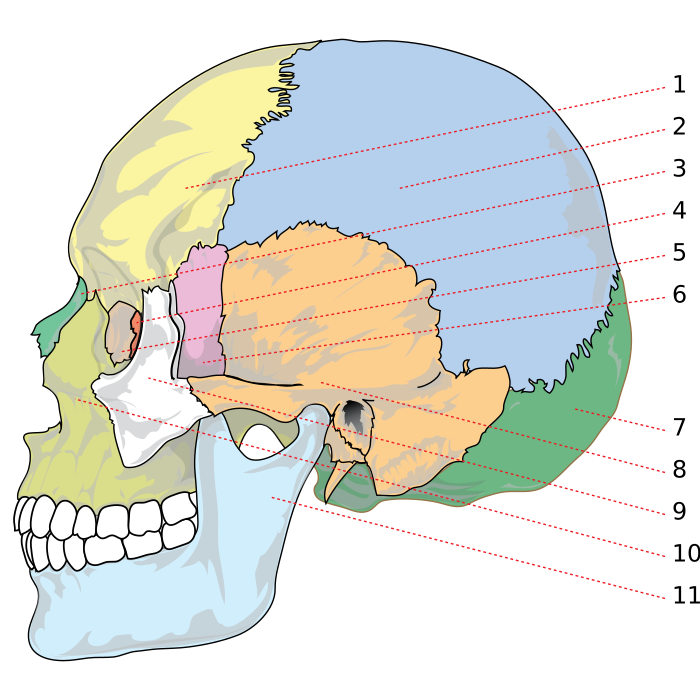
The anchorage anatomy
The Circolare d'Autore® prosthesis
- 14 teeth per arch, including all posterior molars
- Zero fake gum: the teeth emerge from the natural gum
- Zirconia + layered ceramic, with registered trademark ®
- Custom-made: every prosthesis is a unique piece designed for the patient
Discover all the details on the dedicated page: Circolare d'Autore® — the definitive prosthesis without fake gum.