Sphenoid
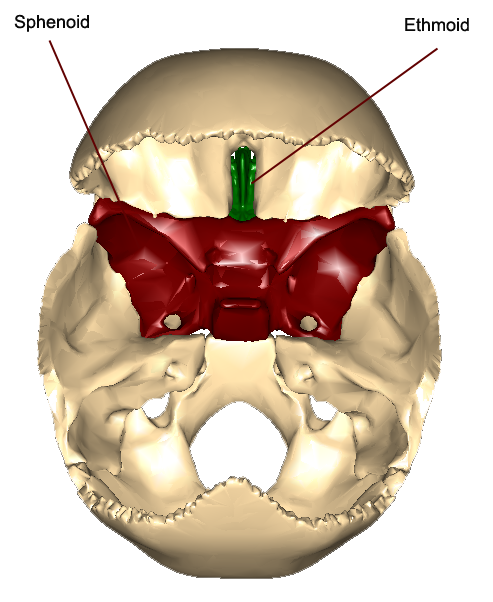
The sphenoid bone is a single, median bone of the cranial base, located in the anterior part of the skull. It is of fundamental importance in implantology Bilateral Sinus Solution™ (BSS) because it provides the terminal cortical anchorage for the pterygoid implants.
| Sphenoid Bone | |
|---|---|
| Type | Skull bone (cranial base) |
| Position | Antero-medial of the cranial base |
| Pterygoid processes | Medial and lateral plates |
| Density | D1 (compact cortical) |
| Role in BSS | Apical anchorage of the implant |
| Anchorage zone | ~1 cm in the cortical plates |
Anatomy of the sphenoid
The sphenoid bone is a single bone of the cranial base. For implantological purposes, the most important structures are the pterygoid processes, made of lateral plate and medial plate, between which the pterygoid fossa is formed. The cortical plates of the sphenoid have D1 density, the highest in the Lekholm and Zarb classification, ideal for bicortical anchorage.
The sphenoid bone is made of several anatomical parts. For the purposes of basal implantology, the most important structure is represented by the pterygoid processes.
Pterygoid processes
The pterygoid processes are two vertical bone plates that extend from the lower face of the body of the sphenoid. Each process is made of:
- Lateral plate (external pterygoid wing): shorter and wider, gives insertion to the pterygoid muscles
- Medial plate (internal pterygoid wing): longer and thinner, contributes to forming the lateral wall of the nasal cavity
Between the two plates the pterygoid fossa is formed, where the medial pterygoid muscle inserts.
Bone density
The cortical plates of the sphenoid have a D1 density, the highest in the Lekholm and Zarb classification. This characteristic makes them the ideal site for the bicortical anchorage of the pterygoid implants.
The role of the sphenoid in the Bilateral Sinus Solution™ (BSS)
In the Bilateral Sinus Solution™ (BSS), the pterygoid implant starts from the maxillary tuber, crosses the pyramidal process of the palatine bone and anchors for about 1 centimetre in the cortical plates of the sphenoid. This bicortical anchorage in D1 bone guarantees a torque above 50 Ncm, allowing immediate loading. The sphenoid bone is not subject to resorption because it belongs to the cranial base.
In the Bilateral Sinus Solution™ (BSS), the pterygoid implant:
- Starts from the maxillary tuber
- Crosses the pyramidal process of the palatine bone
- Anchors for about 1 centimetre in the cortical plates of the sphenoid
This bicortical anchorage in the sphenoid plates is the secret of the primary stability of the technique. The D1 cortex guarantees a high insertion torque (above 50 Ncm) that allows immediate loading.
Advantages of the anchorage in the sphenoid
- Maximum bone density: D1, the best for osseointegration
- Excellent primary stability: allows immediate loading
- Bone not subject to resorption: it is part of the cranial base
- Safety distance: the maxillary artery passes about 25 mm above the pterygopalatine suture
Surgical safety
The insertion area of the pterygoid implant in the sphenoid is considered safe for the absence of vital structures in the implant path. The maxillary artery passes about 25 mm above the pterygopalatine suture, offering an adequate safety margin. The only risk is venous bleeding from the pterygoid plexuses, which resolves after the insertion of the implant.
The insertion area of the pterygoid implant in the sphenoid is considered safe for the absence of vital structures in the implant path. The only risk is represented by venous bleeding from the pterygoid venous plexuses, which resolves promptly after the insertion of the implant.
Video: the anchorage areas
Zone 18 — 21×4.5 implant in the cortical plates of the sphenoid
The left posterior pillar: bicortical anchorage, torque 100-150 N.
Zone 28 — 21×4.5 implants in posterior basal bone
The right posterior pillar: bone that never resorbs.
The Circolare d'Autore® prosthesis
- 14 teeth per arch, including all posterior molars
- Zero fake gum: the teeth emerge from the natural gum
- Zirconia + layered ceramic, with registered trademark ®
- Custom-made: every prosthesis is a unique piece designed for the patient
Discover all the details on the dedicated page: Circolare d'Autore® — the definitive prosthesis without fake gum.