Implantology
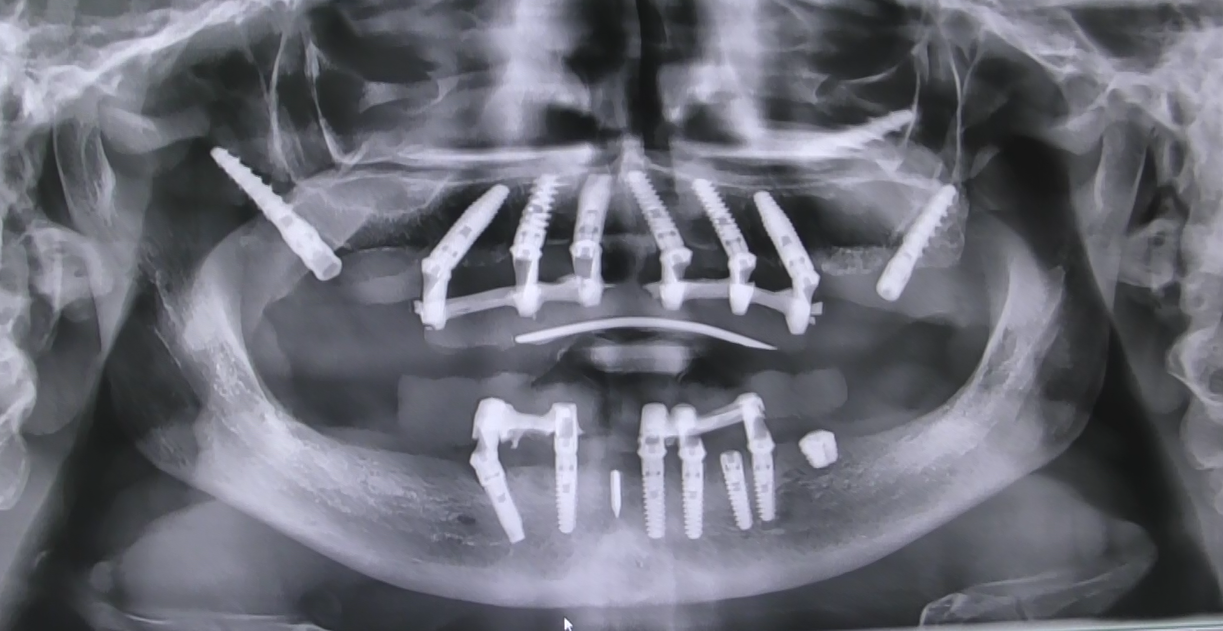
Implantology is the branch of dentistry that deals with the replacement of missing teeth through the placement of dental implants in the maxillary or mandibular bone. The implants act as artificial roots on which fixed or removable prostheses are subsequently mounted.
Types of implantology
Implantology is mainly divided into traditional, basal and zygomatic. Traditional implantology requires sufficient alveolar bone and often needs grafts; basal implantology (Bilateral Sinus Solution™ (BSS)) uses the D1-D2 basal bone avoiding grafts and sinus lifts; zygomatic implantology anchors to the zygoma but is more invasive than the BSS technique.
Traditional implantology
Traditional implantology involves the placement of implants in the alveolar bone. It requires a sufficient quantity and quality of bone. In case of atrophy, complementary procedures such as bone grafts or maxillary sinus lifts are necessary.
Basal implantology
Basal implantology uses the basal bone, a deeper and more stable bone portion that never resorbs over time. This technique allows avoiding bone grafts and sinus lifts, reducing times and complications. The Bilateral Sinus Solution™ (BSS) of the Nicola Lettera Maxillofacial Team is the most advanced expression of basal implantology.
Zygomatic implantology
Zygomatic implantology uses long implants that anchor to the zygomatic bone, an alternative for cases of extreme atrophy. Compared to this, the Bilateral Sinus Solution™ (BSS) is less invasive.
Classification of bone quality
Bone quality is classified according to Lekholm and Zarb in four types: D1 (compact cortical, maximum density), D2 (thick cortical, high), D3 (thin cortical, medium) and D4 (spongy medullary, low). The Bilateral Sinus Solution™ (BSS) uses the D1-D2 basal bone for maximum stability.
| Type | Description | Density |
|---|---|---|
| D1 | Compact cortical bone | Maximum |
| D2 | Thick cortical bone with dense core | High |
| D3 | Thin cortical bone with spongy core | Medium |
| D4 | Spongy medullary bone | Low |
The basal bone used by the Bilateral Sinus Solution™ (BSS) is classified as D1-D2, the highest density, guaranteeing excellent primary stability and the possibility of immediate loading.
When is an implant needed?
Implantology is indicated for the replacement of single missing teeth, multiple missing teeth, complete edentulism, severe bone atrophy and patients who cannot tolerate removable dentures. It restores chewing, aesthetics and phonetics with a definitive result.
Implantology is indicated for:
- Replacement of a single missing tooth
- Replacement of multiple missing teeth
- Complete edentulism (total absence of teeth)
- Severe bone atrophy
- Patients who cannot tolerate removable dentures
The implantology with the Bilateral Sinus Solution™ (BSS) allows restoring chewing, aesthetics and phonetics with a definitive result, even in the most complex cases.
Continue: the BSS technique →