Failed Dental Implant Removal
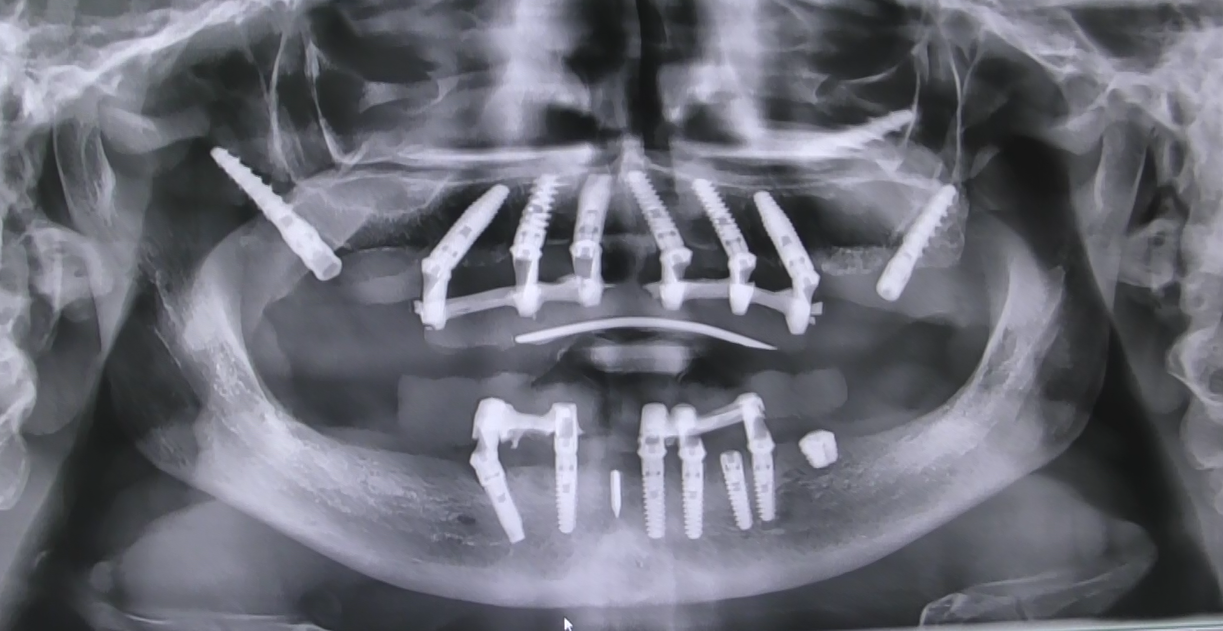
Causes of implant failure
The main causes of implant failure include: peri-implantitis with inflammation and infection of the peri-implant tissues (most common cause of late failure), occlusal overload with excessive masticatory forces, implant fracture, scarce available bone, failed osseointegration for insufficient primary stability and systemic causes such as smoking or diabetes.
Dental implants can fail for several reasons:
- Peri-implantitis: inflammation and infection of the tissues around the implant, with progressive bone loss. It is the most common cause of late failure
- Occlusal overload: excessive masticatory forces that exceed the load capacity of the implant
- Implant fracture: fracture of the implant body or of the abutment screw
- Scarce available bone: implants placed in bone of insufficient quality or quantity, often in resorbed alveolar bone
- Failed osseointegration: early failure for insufficient primary stability or contamination
- Systemic causes: smoking, uncontrolled diabetes, immunosuppressive therapies
Removal procedure
The removal procedure of a failed implant involves: local anaesthesia and flap incision to expose the implant, disconnection of the prosthesis and removal of the abutment, use of specific instruments such as piezoelectric cautery and ultrasonic drills, controlled eversion of the implant minimising the bone loss and curettage of the site to remove granulation tissue and bacterial biofilm.
The removal of a failed implant requires an accurate surgical technique to preserve as much bone as possible:
- Local anaesthesia and flap incision to expose the implant
- Disconnection of the prosthesis and removal of the prosthetic abutment
- Use of specific instruments (piezoelectric cautery, ultrasonic drills, removal forceps)
- Controlled eversion of the implant, minimising the bone loss
- Curettage of the site to remove granulation tissue and biofilm
Decontamination of the tissues
After the removal of the failed implant, the decontamination of the site is fundamental to eliminate: inflammatory granulation tissue that prevents bone regeneration, bacterial biofilm adhered to the bone and soft tissues, and debris such as fragments of necrotic bone or implant material. The decontamination is performed with surgical drills, curettes and antiseptic solutions to prepare the site for reimplantation.
After the removal of the failed implant, it is fundamental to perform an accurate decontamination of the site to eliminate:
- Granulation tissue: inflammatory tissue that prevents bone regeneration
- Bacterial biofilm: bacterial colonies adhered to the bone and soft tissues
- Debris: fragments of necrotic bone or implant material
The decontamination is performed with surgical drills, curettes and antiseptic solutions, preparing the site for a possible reimplantation or for secondary bone healing.
Rehabilitation with BSS after removal
The Bilateral Sinus Solution™ (BSS) is the elective solution of the Nicola Lettera Maxillofacial Team after the removal of failed implants. It offers: new anchorage in healthy basal bone far from the compromised areas, no bone graft, immediate loading with a new fixed prosthesis in 24-48 hours, restoration of the posterior molars for full masticatory function and the Circolare d'Autore® zirconia-ceramic prosthesis without fake gum.
The Bilateral Sinus Solution™ (BSS) is the elective solution after the removal of failed implants:
- New anchorage in healthy basal bone far from the compromised areas
- No bone graft
- Immediate loading with a new fixed prosthesis in 24-48 hours
- Restoration of the posterior molars for full masticatory function
- Circolare d'Autore® zirconia-ceramic prosthesis without fake gum
Retreatment clinical cases
The documentation of the retreatment cases with BSS is available on the Clinical Cases page, with pre- and post-operative radiographs showing the passage from failed implants to a complete, stable and definitive rehabilitation.
The documentation of the retreatment cases with BSS is available on the Clinical Cases page, with pre- and post-operative radiographs showing the passage from failed implants to a complete, stable and definitive rehabilitation.
The Circolare d'Autore® prosthesis
- 14 teeth per arch, including all posterior molars
- Zero fake gum: the teeth emerge from the natural gum
- Zirconia + layered ceramic, with registered trademark ®
- Custom-made: every prosthesis is a unique piece designed for the patient
Discover all the details on the dedicated page: Circolare d'Autore® — the definitive prosthesis without fake gum.