Alveolar Bone
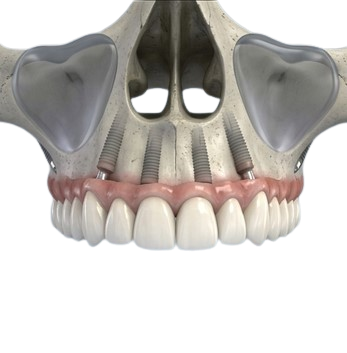

The alveolar bone is the portion of the maxillary and mandibular bone that surrounds and supports the teeth. It develops together with the teeth and resorbs progressively after their loss. It is a bone dependent on dental presence: if the tooth is lost, the alveolar bone resorbs because it no longer receives the mechanical stimuli of chewing.
Characteristics
The alveolar bone is the superficial portion of the maxillary bone that surrounds and supports the teeth. It has variable density from D2 to D4, is subject to progressive resorption after tooth loss and depends on dental presence for its maintenance. It is the bone that atrophies, making it necessary to use the basal bone in BSS.
- Variable density: from D2 to D4, generally less dense than the basal bone
- Subject to resorption: after tooth loss, it resorbs progressively
- Position: superficial, surrounds the roots of the teeth
- Variable thickness: depends on genetic and periodontal factors and on edentulism
Differences with the basal bone
The alveolar bone is superficial, resorbs rapidly after tooth loss and has D2-D4 density. The basal bone is deep, does not resorb and has D1-D2 density. While traditional implantology uses the alveolar bone, the Bilateral Sinus Solution™ (BSS) is based exclusively on the basal bone, eliminating the need for grafts.
| Characteristic | Alveolar Bone | Basal Bone |
|---|---|---|
| Position | Superficial | Deep |
| Resorption | Yes, rapid after tooth loss | Minimal or absent |
| Density | D2-D4 | D1-D2 |
| Stability | Variable | Excellent |
| Use in BSS | Not necessary | Fundamental |
Atrophy of the alveolar bone
When the teeth are lost, the alveolar bone resorbs progressively causing bone atrophy, the main cause of insufficient volume for traditional implantology. The consequences include reduction of bone height and thickness, pneumatisation of the maxillary sinus and the impossibility of placing traditional implants without grafts.
When the teeth are lost, the alveolar bone resorbs progressively. This phenomenon, called bone atrophy, is the main cause of insufficient bone volume for traditional implantology. The Bilateral Sinus Solution™ (BSS) solves this problem by using the basal bone, which is not affected by alveolar atrophy.
Consequences of alveolar atrophy
- Reduction of bone height and thickness
- Pneumatisation of the maxillary sinus
- Impossibility of placing traditional implants
- Need for alternative techniques such as the Bilateral Sinus Solution™ (BSS)
Chewing on the alveolar road (spongy bone)
The alveolar bone reacts to chewing based on the principle of the adaptive biological response.
The mechanism: when you chew hard food, the vertical and lateral forces are distributed along the body of the screw and absorbed by the dense network of trabeculae of the spongy bone. This tissue acts almost like a natural "shock absorber".
The long-term advantage: if the load is correct, the micro-stresses stimulate the osteoblasts to keep the bone dense around the threads of the implant.
The masticatory weak point: stability is linked to the maintenance of the most superficial millimetre of bone (alveolar crest). If the gum becomes inflamed or there is a minimal marginal bone loss, the chewing lever increases, weakening the stability of the screw from the upper side.
Learn more: alveolar vs basal chewing →
The Circolare d'Autore® prosthesis
- 14 teeth per arch, including all posterior molars
- Zero fake gum: the teeth emerge from the natural gum
- Zirconia + layered ceramic, with registered trademark ®
- Custom-made: every prosthesis is a unique piece designed for the patient
Discover all the details on the dedicated page: Circolare d'Autore® — the definitive prosthesis without fake gum.