Bilateral Sinus Solution™ (BSS) — Complete Explanation
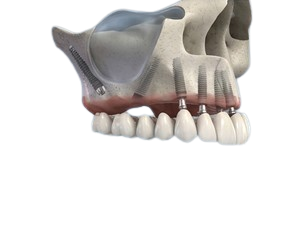
Explanatory video of the Bilateral Sinus Solution™ (BSS) technique — Nicola Lettera Maxillofacial Team (click to play)
- 1 Introduction
- 2 The problem: maxillary atrophy
- 3 The solution: basal bone
- 4 History of the technique
- 5 Implant configuration
- 6 Advantages
- 7 Comparison with All-on-4 and Zygomatic
- 8 Decontamination and re-grafting
- 9 Preservation of the papillae
- 10 Temporary prosthesis
- 11 Circolare d'Autore®
- 12 Biomechanics
- 13 Limits of All-on-4/6
- 14 Peri-implantitis
- 15 Specialist visit
1. Introduction
The Bilateral Sinus Solution™ (BSS) is a basal implantology technique developed by the Nicola Lettera Maxillofacial Team after over 3,000 cadaver dissections. The name derives from the "cerclage" of the maxillary sinus: the implants are placed around the sinus bypassing it. It allows obtaining 14 fixed teeth per arch with complete chewing, without fake gum, in about 2 hours with immediate loading.
The Bilateral Sinus Solution™ (BSS) is a surgical basal implantology technique developed by the Nicola Lettera Maxillofacial Team after years of research and over 3,000 cadaver dissections. The name derives from the concept of "cerclage" of the maxillary sinus: the pterygoid and transverse nasal implants are placed around the sinus, completely bypassing it, without ever manipulating it.
This technique allows obtaining 14 fixed teeth per arch with complete chewing (posterior molars included), without fake gum, in about 2 hours of procedure, with immediate loading.
2. The problem: atrophy of the upper jaw
Tooth loss causes the resorption of the alveolar bone and the pneumatisation of the maxillary sinus, creating a posterior bone gap that prevents the traditional implants. The classic solutions (bone grafts and sinus lift) are invasive, painful and require 6-12 months of waiting. The Bilateral Sinus Solution™ (BSS) offers an effective and minimally invasive alternative.
When the teeth are lost, the alveolar bone progressively resorbs. In the upper jaw, the pneumatisation of the maxillary sinus is added to this, expanding and occupying the lost bone space. The result is a posterior bone gap that makes the placement of traditional implants impossible.
The traditional techniques to solve this problem require:
- Bone grafts with harvesting from hip, skull or mandible: invasive procedure, 6-12 months of waiting, significant post-operative pain
- Maxillary sinus lift (Sinus Lift): complex procedure with risks of perforation of the sinus membrane
Many patients cannot or do not want to undergo these procedures. The Bilateral Sinus Solution™ (BSS) offers an effective and minimally invasive alternative.
3. The solution: the basal bone
The key of the Bilateral Sinus Solution™ (BSS) is the use of the basal bone, a deep D1-D2 bone portion that does not resorb with tooth loss. While the alveolar bone is superficial and dependent on the teeth, the basal bone is the load-bearing structure of the facial mass and remains intact for life. BSS does not reconstruct the lost bone but uses the always present healthy bone.
The key of the Bilateral Sinus Solution™ (BSS) is the use of the basal bone, a deep, stable and D1-D2 type bone portion that does not resorb with age or with tooth loss.
While the alveolar bone is superficial and depends on the presence of the teeth for its maintenance, the basal bone is the load-bearing structure of the facial mass and remains intact for life. It is precisely in this bone that the pterygoid implants are anchored.
4. History of the technique
Since 1997, the Nicola Lettera Maxillofacial Team has developed the Bilateral Sinus Solution™ (BSS) through over 3,000 dissections on cadavers. The anatomical study allowed mapping the usable bone areas (cortical plates of the sphenoid, hard palate, premaxilla), identifying the optimal insertion angle (45°-60°) and verifying the mechanical resistance above 200 Ncm of the implants.
Since 1997, the Nicola Lettera Maxillofacial Team has begun exploring alternative solutions to the traditional techniques. Through over 3,000 dissections on cadavers and years of research, it has developed and perfected the Bilateral Sinus Solution™ (BSS).
The anatomical study allowed:
- Mapping the usable bone areas for the implants (cortical plates of the sphenoid, hard palate, premaxilla)
- Identifying the optimal insertion angle (45°-60°)
- Designing specific implant apices for the anchorage in the cortical plates
- Verifying the mechanical resistance: the implants demonstrated a resistance above 200 Ncm
The result is a highly predictable technique, based on a detailed understanding of the human anatomy, that offers immediate and stable results.
5. Implant configuration
The implant configuration of the Bilateral Sinus Solution™ (BSS) is personalised according to the patient's anatomy, from a minimum of 6 to a maximum of 12 implants. Typically it includes 2 pterygoid implants (19-21 mm) in the posterior area with bicortical anchorage in the sphenoid, 2 transverse nasal implants in the retrocanine fossae area to bypass the sinus, and 2-4 sub-nasal implants in the frontal area. The result is a uniform distribution of the loads over the whole perimeter of the arch.
The personalised implant configuration of the Bilateral Sinus Solution™ (BSS) involves the strategic placement of implants in three areas:
Posterior area (18/28) — Pterygoid implants
- 2 pterygoid implants 19-21 mm long
- Placed with an inclination of 45°-60°
- Cross the maxillary tuber and anchor for about 1 cm in the cortical plates of the sphenoid
- Bicortical anchorage: torque > 50 Ncm, immediate loading possible
Mid-anterior area (15/25) — Transverse nasal implants
- 2 transverse nasal implants in the retrocanine fossae area
- Anchored in the extremely hard bone of the retrocanine fossae (NOT basal implants)
- Bypass the maxillary sinus laterally
- Stabilise the prosthesis in the central area
Frontal area (4/6) — Sub-nasal implants
- 2-4 sub-nasal implants or blade implants
- Complete the support of the arch
The result is a uniform distribution of the masticatory loads on a variable number of implants (from 6 to 12) covering the whole perimeter of the upper jaw, personalised according to the patient's anatomy.
6. Advantages compared to the alternatives
The Bilateral Sinus Solution™ (BSS) offers decisive advantages: no bone graft, no maxillary sinus lift, immediate loading with fixed teeth in 24-48 hours, complete chewing with all posterior molars, absence of fake gum, permanent zirconia-ceramic prosthesis and fast recovery with a procedure of about 2 hours under local anaesthesia.
Without bone grafts
No harvesting from hip, skull or mandible. No second surgical site.
Without sinus lift
The implants bypass the maxillary sinus. No sinus manipulation.
Immediate loading
Fixed teeth in 24-48 hours. Torque > 50 Ncm, immediate temporary prosthesis.
Posterior molars
Complete chewing with all molars. No posterior cantilevers.
Without fake gum
Zirconia-ceramic prosthesis. Natural appearance, the teeth emerge from the gum.
Fast recovery
Procedure of ~2 hours under local anaesthesia. Return to activities in 24-48 hours.
7. Comparison with the traditional techniques
Compared to All-on-4/6 and Quad-4 zygomatic, the Bilateral Sinus Solution™ (BSS) is the only technique that offers all the posterior molars, permanent zirconia-ceramic prosthesis without fake gum, 14 teeth per arch, from 6 to 12 personalised implants, normal oral hygiene and very low peri-implantitis risk. All-on-4/6 and zygomatic have composite prostheses to replace every 4-5 years.
| Characteristic | All-on-4 / All-on-6 | Quad-4 Zygomatic | Bilateral Sinus Solution™ (BSS) |
|---|---|---|---|
| Molar coverage | Only up to the canines | Only up to the canines | Complete (molars included) |
| Prosthesis duration | 4-5 years (composite) | 4-5 years (composite) | Permanent (zirconia-ceramic) |
| Fake gum | Present and evident | Present and abundant | Absent — natural appearance |
| Bone grafts | Often necessary | Not necessary | Never necessary |
| Sinus lift | Often necessary | Not necessary | Never necessary |
| Immediate loading | Possible | Possible | Always possible |
| Complete chewing | No | No | Yes |
| Prosthesis replacement | Every 4-5 years | Every 4-5 years | Never necessary |
| Number of teeth | 10-12 | 10-12 | 14 |
| Support points | 4-6 (anterior) | 4 (zygomatic) | 6-12 (whole perimeter) |
| Oral hygiene | Difficult (fake gum) | Difficult (fake gum) | Normal (separate teeth) |
| Peri-implantitis risk | High | High | Very low |
The Bilateral Sinus Solution™ (BSS) is the only technique that offers all the posterior molars, without fake gum, with definitive zirconia-ceramic prosthesis that does not need periodic replacement.
8. Surgical decontamination and bone re-grafting
Before the implant placement, BSS performs a radical surgical decontamination removing cysts, chronic infections, non-recoverable teeth and necrotic tissue. The missing bone volume is re-grafted with biocompatible apatite bone as a three-dimensional scaffold for the regeneration. This step is fundamental to maintain the volumes needed for the aesthetics without fake gum.
A fundamental and often underestimated phase of the BSS procedure is the surgical decontamination. Before placing any implant, the surgeon performs an accurate and radical cleaning of the surgical site, removing:
- Cysts and apical granulomas
- Chronic infections and granulation tissue
- Non-recoverable teeth and residual roots
- Alveoli and necrotic bone tissue
- Thickened or pathological sinus membranes (if necessary)
Only after completely decontaminating the surgical field the implant placement proceeds. At this point, the missing bone volume (deficit created by the removal of the pathological tissues and by the pre-existing atrophy) is re-grafted with biocompatible apatite bone. This osteoconductive material acts as a three-dimensional scaffold for the natural bone regeneration.
9. Preservation of the gingival papillae
BSS preserves the gingival papillae by immediately screwing a temporary prosthesis after the extraction and the implant placement, keeping the gums tight and supported for 6 months. The All-on-4/6 and zygomatic techniques do not preserve the papillae and must hide the gingival collapse with fake gum in pink resin. It is the secret of the BSS aesthetics without fake gum.
The aesthetics of the smile does not depend only on the teeth, but also on the health and the shape of the gingival papillae, the triangular spaces of gum between one tooth and the other. When the teeth are lost, the gingival papillae collapse and disappear, creating unaesthetic black spaces (black triangles) between the teeth of the prosthesis.
BSS solves this problem in an innovative way: right after the extraction of the teeth and the placement of the implants, a temporary prosthesis is immediately screwed that keeps the gums tight and supported. This temporary prosthesis has the task of preserving the gingival papillae and the gingival arches for all the 6 months of waiting before the definitive prosthesis.
This is the secret why BSS can afford not to use fake gum: the gingival papillae have been preserved and when the Circolare d'Autore® in ceramic is applied, the gums present themselves perfectly formed, with the teeth that seem to emerge directly from the natural gum like real teeth.
10. The temporary prosthesis: it keeps the gums perfect for 6 months
The BSS temporary prosthesis, screwed immediately after the procedure, performs a fundamental aesthetic function: it maintains the gingival morphology and the papillae for 6 months, preparing the bed for the definitive Circolare d'Autore®. It is the key to the natural emergence of the teeth from the gum.
The temporary prosthesis in the BSS is not a simple provisional: it is an aesthetic instrument that:
- Maintains the gingival morphology during the healing
- Preserves the gingival papillae
- Keeps the prosthetic spaces
- Allows an immediate chewing with soft foods
- Prepares the bed for the definitive Circolare d'Autore®
11. The Circolare d'Autore® — the definitive prosthesis
The Circolare d'Autore® is the definitive prosthesis of the Network: 14 zirconia-ceramic teeth without fake gum, all molars, custom-made. It is designed as a unique piece and does not require periodic replacement.
How it is made
- Intraoral digital scan
- CAD design of the zirconia structure
- CNC milling with micrometric precision
- Aesthetic ceramic layering in several firings
- Definitive screwing on the implants
Characteristics of the Circolare d'Autore®
- 14 teeth per arch, including all the molars
- No fake gum
- Zirconia + layered ceramic
- Permanent, no periodic replacement
12. Masticatory biomechanics: why the molars are essential
The molars generate 5-6 times more force than the anterior teeth. Without them, all the force concentrates on the premaxilla, overloading the anterior implants and deforming the bone. BSS restores all the molars with the posterior pillars in 18/28, distributing the force over the whole perimeter of the arch.
The problem of forced frontal chewing
When the molars are missing, the patient is forced to chew only in front: all the force concentrates on the premaxilla (canine-to-canine area), overloading the anterior implants, deforming the bone and causing failures over time.
The BSS solution
With the posterior pillars in 18/28 and the implants in 15/25, BSS restores all the molars and distributes the force over the whole perimeter of the arch, like in a natural dentition. The masseter reactivates and the chewing returns to 100%.
13. All-on-4/6: limitations and long-term risks
The All-on-4/6 techniques place the implants only in the anterior area: they leave the patient without posterior molars, with mandatory cantilever, fake gum and overload of the anterior pins. The long-term risks include progressive bone resorption, peri-implantitis and premature failure.
Structural limitations
- Implants only in the premaxilla
- Missing posterior molars
- Mandatory cantilever
- Fake gum to fill the void
Long-term risks
- Overload of the anterior implants
- Progressive bone resorption
- Peri-implantitis favoured by the fake gum
- Premature failure
14. Peri-implantitis: the hidden risk of the fake gum
The fake gum creates closed spaces under the prosthesis where food and bacteria stagnate, favouring the peri-implantitis. BSS eliminates the fake gum and the hidden areas: hygiene is simple and the peri-implantitis risk is very low.
Why the fake gum favours the peri-implantitis
The fake gum (pink acrylic flange) creates closed spaces under the prosthesis where food and plaque inevitably stagnate. Cleaning is difficult and the bacterial accumulation triggers chronic infections that lead to the loss of the implants.
BSS eliminates the problem
With the prosthesis without fake gum, the teeth emerge from the natural gum and the hygiene is simple as with natural teeth: no hidden areas, no stagnation, no peri-implantitis.
15. Specialist visit in Bergamo
For the evaluation of your case, book a free specialist visit with the Nicola Lettera Maxillofacial Team in Bergamo: WhatsApp +39 388 7527525, email consultidentali@gmail.com. The visit includes the analysis of the radiographs and the personalised treatment plan.
Book a specialist visit
For the evaluation of your case, book a free specialist visit with the Nicola Lettera Maxillofacial Team in Bergamo:
- WhatsApp: +39 388 7527525
- Email: consultidentali@gmail.com
The visit includes the analysis of the radiographs and the personalised treatment plan.
Zone 18 — 21×4.5 implant in the cortical plates of the sphenoid
Zone 15 — 19×4.5 implant in the retrocanine fossa
Zone 28 — 21×4.5 implants in posterior basal bone
Zone 25 — 19×4.5 implant in the retrocanine fossa
The Circolare d'Autore® prosthesis
- 14 teeth per arch, including all posterior molars
- Zero fake gum: the teeth emerge from the natural gum
- Zirconia + layered ceramic, with registered trademark ®
- Custom-made: every prosthesis is a unique piece designed for the patient
Discover all the details on the dedicated page: Circolare d'Autore® — the definitive prosthesis without fake gum.