Pterygoid Implant
| Pterygoid Implant | |
|---|---|
| Length | 19-21 mm |
| Diameter | 3.7-5.0 mm |
| Inclination | 45°-60° (sagittal) |
| Lateral inclination | 10°-15° (vestibulo-palatal) |
| Anchorage | Basal bone |
| Osseointegration | 94.87% success |
| Technique | Bilateral Sinus Solution™ (BSS) |

The pterygoid implant is a long dental implant (19-21 mm) used for the rehabilitation of the posterior sectors of the upper jaw in case of severe bone atrophy. It is placed in the region of the maxillary tuberosity and extends to the bone plates of the sphenoid, where it finds a cortical anchorage of extreme stability.
Anatomy of the pterygoid area
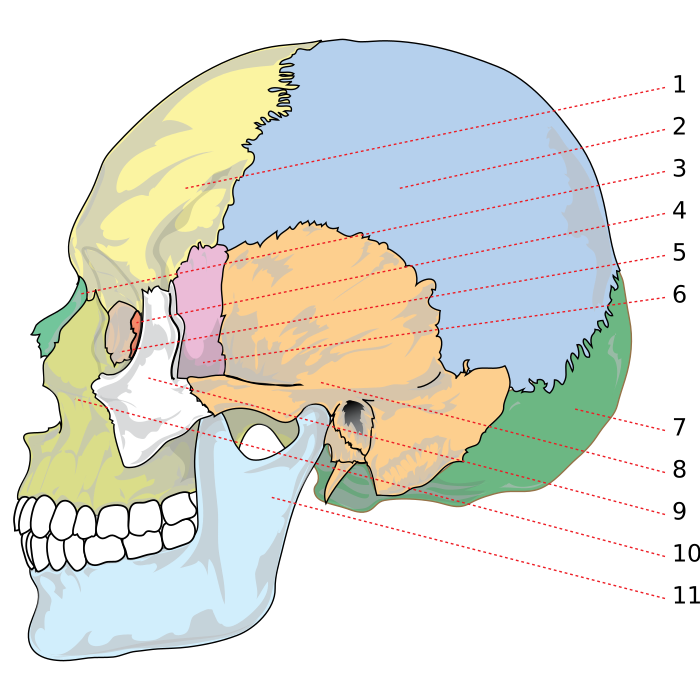
The pterygoid area is a complex anatomical region made of three structures: the maxillary tuberosity, the pterygoid processes of the sphenoid and the pyramidal process of the palatine bone. These structures are joined by synostosis sutures, creating a region of maximum mechanical resistance. The pterygoid muscles maintain bone trophism with their tractions.
The pterygoid area is a complex anatomical region located posteriorly to the maxillary arch. It is made of three bone structures:
- Maxillary tuberosity: posterior convex part of the maxillary bone
- Pterygoid processes (vertical) of the sphenoid: vertical bone plates extending downwards
- Pyramidal process of the palatine bone: intermediate structure between maxilla and sphenoid
These three structures are assembled with synostosis bone sutures, creating a region of maximum mechanical resistance. The medial and lateral pterygoid muscles exert tractions that maintain the trophism of the bone.
Vascularisation
The area is vascularised by branches of the maxillary artery:
- Descending palatine artery: runs between palatine bone and maxilla
- Antro-alveolar artery: supplies the maxillary sinus
- Supero-posterior alveolar arteries: supply the tuberosity area
Technical characteristics
The pterygoid implant measures 19-21 mm in length and 3.7-5.0 mm in diameter, with a conical shape for maximum stability. It is placed with a sagittal inclination of 45°-60° and a vestibulo-palatal inclination of 10°-15°. The path goes from the maxillary tuberosity through the pyramidal process of the palatine bone to the cortical plates of the sphenoid, creating a bicortical anchorage with torque above 50 Ncm.
Dimensions
- Length: 19-21 mm. Implants of 10-13 mm are called "fake pterygoids" because they anchor only in the tuber without reaching the sphenoid plates, losing the fundamental bicortical anchorage.
- Diameter: 3.7-5.0 mm, conical shape for maximum primary stability
Insertion angulation
- Sagittal plane: 45°-60° relative to the Frankfurt plane
- Vestibulo-palatal plane: 10°-15°
Implant path
The implant follows a precise anatomical path:
- Start from the maxillary tuberosity (intraoral access)
- Crossing of the maxillary tuber
- Passage through the pyramidal process of the palatine bone
- Final anchorage in the cortical plates of the sphenoid (about 1 cm)
Primary stability
Thanks to the anchorage in the basal bone of D1/D2 type, the pterygoid implants achieve an insertion torque above 50 Ncm, sufficient for immediate loading. This stability is comparable or superior to that of traditional implants placed in healthy native bone.
Advantages of the pterygoid implant
The pterygoid implant offers anchorage in D1-D2 basal bone with maximum stability, bypasses the maxillary sinus without the need for lifts, avoids bone grafts, allows immediate loading in 24-48 hours, eliminates posterior cantilevers optimally distributing the masticatory loads, and has a high success rate of 94.87% at 132 months of follow-up.
- Anchorage in D1-D2 basal bone: maximum density and stability
- Bypasses the maxillary sinus: no sinus lift required
- Avoids bone grafts: no donor site harvesting needed
- Immediate loading possible: fixed prosthesis in 24-48 hours
- Eliminates posterior cantilevers: optimal load distribution
- High success rate: 94.87%
Success rates
Clinical studies on 1,893 pterygoid implants (634 patients, 12-132 months follow-up) demonstrate a success rate of 94.87%. Failures during osseointegration represent about 3% (related to incorrect positioning), while failures under prosthetic load are below 1%, confirming the excellent predictability of the BSS technique.
Clinical studies on 1,893 pterygoid implants (634 patients, 12-132 months follow-up) have demonstrated:
- Success rate: 94.87%
- Failures during osseointegration: ~3% (related to incorrect positioning)
- Failures under prosthetic load: <1%
Video: the anchorage areas
Zone 18 — 21×4.5 implant in the cortical plates of the sphenoid
The left posterior pillar: bicortical anchorage, torque 100-150 N.
Zone 28 — 21×4.5 implants in posterior basal bone
The right posterior pillar: bone that never resorbs.
The Circolare d'Autore® prosthesis
- 14 teeth per arch, including all posterior molars
- Zero fake gum: the teeth emerge from the natural gum
- Zirconia + layered ceramic, with registered trademark ®
- Custom-made: every prosthesis is a unique piece designed for the patient
Discover all the details on the dedicated page: Circolare d'Autore® — the definitive prosthesis without fake gum.