Bilateral Sinus Solution™ (BSS)
| Bilateral Sinus Solution™ (BSS) | |
|---|---|
| Developed by | Nicola Lettera Maxillofacial Team |
| Year | Developed since 1997 |
| Specialty | Basal implantology |
| Area of intervention | Atrophic upper jaw |
| Anchorage | Basal bone |
| Procedure duration | ~2 hours |
| Loading | Immediate (temporary in 1 hour) |
| Grafts | Not required |
| Sinus lift | Not required |
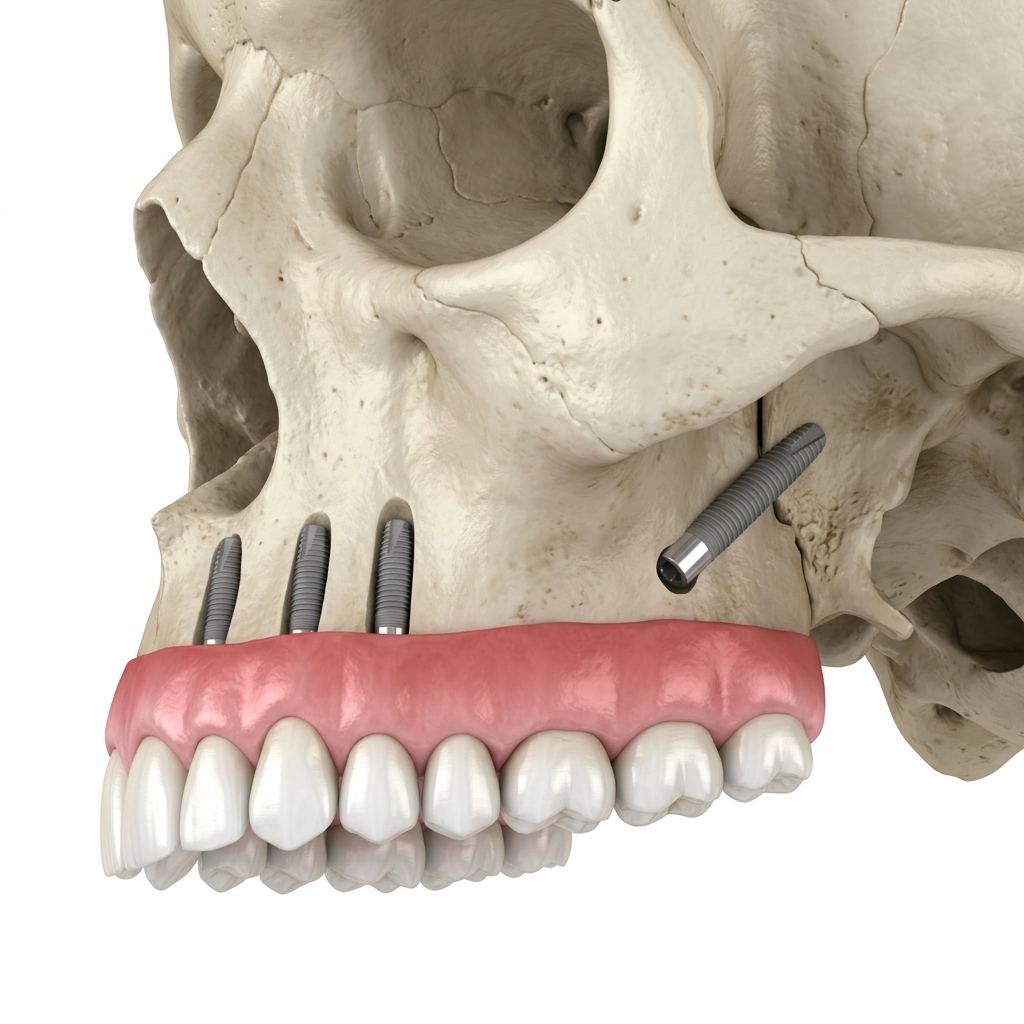
The Bilateral Sinus Solution™ (BSS) is an innovative implantology basal surgical technique, developed by the Nicola Lettera Maxillofacial Team, designed for the rehabilitation of the upper jaw affected by severe bone atrophy. The name derives from the concept of "cerclage" of the maxillary sinus: the implants are placed around the sinus, bypassing it, without having to manipulate it.
History
Since 1997, the Nicola Lettera Maxillofacial Team has developed the Bilateral Sinus Solution™ (BSS) by exploring alternative solutions for atrophic jaws. Focusing on pterygoid implants, they discovered that it was possible to bypass the maxillary sinus and use the basal bone, eliminating the need for invasive sinus procedures and bone grafts.
Since 1997, the Nicola Lettera Maxillofacial Team has begun exploring alternative solutions to traditional techniques for the rehabilitation of atrophic jaws. Focusing on the use of pterygoid implants, they discovered that it was possible to bypass the maxillary sinus and use stable bone areas such as the basal bone, eliminating the need for invasive procedures on the sinuses themselves.
Surgical concept
The founding principle of the Bilateral Sinus Solution™ (BSS) is the use of the basal bone as the primary anchorage site. While the alveolar bone resorbs after tooth loss, the basal bone remains intact. The strategic placement of the implants "girdles" the maxillary sinus without ever entering it, creating a peripheral support for the upper arch.
The founding principle of the Bilateral Sinus Solution™ (BSS) is the use of the basal bone as the primary anchorage site. While the alveolar bone resorbs after tooth loss (causing atrophy), the basal bone remains intact and available for implant placement.
The strategic placement of the implants "girdles" the maxillary sinus, creating a peripheral support for the upper arch without ever entering the sinus itself.
Implant configuration
The implant configuration is customised according to the patient's bone anatomy, from a minimum of 6 to a maximum of 12 implants. In the posterior area (18/28) 2 pterygoid implants of 19-21 mm inclined at 45°-60° are placed, crossing the tuber and anchoring in the cortical plates of the sphenoid; in the mid-anterior area (15/25) 2 transverse nasal implants in the bone of the retrocanine fossae; and in the frontal area (4/6) 2-4 subnasal or blade implants.
The customised implant configuration involves the placement of:
Posterior area (18/28)
- 2 pterygoid implants (19-21 mm)
- Placed with an inclination of 45°-60°
- Cross the maxillary tuber
- Anchor in the cortical plates of the sphenoid for about 1 cm
Watch the placement of the strategic implants in the posterior area:
The strategic implant beyond the sinus
This is the implant that avoids sinus lifts and gives you all your molars.
Zone 18 — placement of the 21×4.5 pterygoid implant
Left posterior pillar: bicortical anchorage in the sphenoid plates, torque 100-150 N.
Zone 28 — placement of the 21×4.5 implants
Right posterior pillar: basal bone that never resorbs.
Mid-anterior area (15/25)
- 2 transverse nasal implants
- Placed in the retrocanine fossae area
- Anchored in the extremely hard bone of the retrocanine fossae (NOT basal implants)
Watch the placement of the strategic implants in the mid-anterior area:
Zone 15 — placement of the 19×4.5 implant
Left retrocanine fossa: extremely hard bone, torque 100-120 N.
Zone 25 — placement of the 19×4.5 implant
Right retrocanine fossa: the circle of the four zones closes.
Frontal area (4/6)
- 2-4 subnasal implants or blade implants
- Stabilise the prosthesis in the anterior area

Mechanism of action
The technique is based on three pillars: the bicortical anchorage of the pterygoid implant in the tuber and in the sphenoid plates, the distribution of masticatory loads on the natural resistance pillars of the facial skeleton, and the cerclage of the maxillary sinus with implants placed around the sinus without manipulating it, preserving its anatomical integrity.
The technique is based on three fundamental pillars:
- Bicortical anchorage: the pterygoid implant crosses the tuber and locks into the cortical plates of the sphenoid, creating a bicortical anchorage of extreme stability
- Load distribution: the implants distribute the masticatory forces on the natural resistance pillars of the facial skeleton
- Sinus cerclage: the implants are placed around the maxillary sinus without manipulating it, preserving its integrity
Main advantages
The main advantages of the Bilateral Sinus Solution™ (BSS) include: no bone graft, no maxillary sinus lift, immediate loading with a fixed prosthesis in 24-48 hours, minimal invasiveness compared to traditional techniques, fast recovery, zirconia-ceramic prosthesis without fake gum and complete chewing with posterior molars.
- No bone graft (avoids harvesting from hip, skull or mandible)
- No maxillary sinus lift
- Immediate loading: fixed prosthesis in 24-48 hours
- Less invasive than traditional techniques
- Fast recovery
- Zirconia-ceramic prosthesis without fake gum
- Complete chewing with posterior molars
For a complete list, visit the page Advantages of the technique.
The complete BSS protocol: how it works today
The Bilateral Sinus Solution™ (BSS) protocol is organised in 4 points: 1) the two posterior pillars 18/28, basal implants of 19/21 mm in the cortical plates of the sphenoid (D1 bone), the base of mastication; 2) the two 15/25 implants in the retrocanine fossae that stabilise the frontal area; 3) custom solutions for the premaxilla (transverse, nasal, subnasal, spinal, split crest, blade, reverse drills); 4) in the most severe cases the grid with 4/6 implants. Immediate loading in 1 hour, temporary already without fake gum.
The Bilateral Sinus Solution™ (BSS) was born from years of field work, from thousands of real cases: patients who arrive after twenty years of dentures, two failures, bone consumed front and back, negative diagnoses, wrong attempts, failed All-on-4, failed All-on-6, zygomatic implants proposed as the only solution. These are the most difficult patients, those who "have no bone". Yet they are rehabilitated with a single technique, always the same, always complete, always based on the patient's real anatomy.
- The two posterior pillars 18/28 — always. They are the base of mastication: they divide the load between back and front, avoid destroying the anterior implants and allow chewing everything, immediately. They are not "10 or 13 mm pterygoid implants in the tuber": they are basal implants of 19/21 mm that enter the cortical plates of the sphenoid (D1). Absolute stability, no compromises
- The two anterior 15/25 in the retrocanine fossae — they stabilise the frontal area, allow the structure to be built and guarantee aesthetics and function
- In front, what the bone allows — every premaxilla is a story in itself: transverse, nasal, subnasal, spinal implants, split crest, blade implants, reverse drills that compact the bone. There is no single model: there is the patient
- In the most severe cases (everything is missing, back and front) — never zygomatic implants: behind, 2 posterior basal implants that support all mastication, in front a grid with 4/6 implants that recreates the missing bone base
Immediate loading in 1 hour: the patient leaves with the temporary already without fake gum. Already stable, already functional, already aesthetic.
Why it always works
Because BSS is not a technique: it is a method. A protocol that adapts to the patient's bone conditions, not the other way around. When a surgery is born from real anatomy, uses the basal bone, avoids what is not needed, divides the load, respects biomechanics, restores the molars and eliminates fake gum: then it works, always, for everyone.
The Network's surgery is not commercial, not fashionable, not an aesthetic variant of already seen techniques. It is a biological method, an anatomical protocol, built to measure for every patient. Pre-made schemes are not followed: the patient's bone is followed. And the patient's bone, when it is scarce or consumed, is not the alveolar bone: it is the basal bone. Hard, deep, stable. The only one that allows a real rehabilitation.
BSS eliminates the failures of the past because it anchors exclusively to the basal and cortical bone, the only one able to guarantee solid and long-lasting stability, ideal for those who have consumed bone both front and back. Discover how BSS solves all the failures of traditional techniques.
The results: all molars, without fake gum
BSS restores all the molars for strong and complete chewing: an arch of 14 ceramic teeth, without fake gum, with immediate loading. The goal is a single implantology in a lifetime, eliminating forever reworks and clinical odysseys.
- Zero maxillary sinus lifts: months of waiting and heavy surgery are avoided
- No zygomatic implants: a solution respectful of the body and natural physiognomy
- All molars recovered: strong and complete chewing (arch of 14 ceramic teeth)
- Zero fake gum: no bulky plastic flanges, the smile emerges from natural tissues
- One procedure, once in a lifetime: thanks to the stability of the basal bone
Discover more about the restoration of 100% of chewing force and the role of the masseter and molars.
The technique in video
Watch the Bilateral Sinus Solution™ (BSS) in action: real procedures and extreme cases solved. Press play to watch the videos here. See all the videos of the channel →
2️⃣ Implants without grafts: the revolution
The video that explains why BSS eliminates bone grafts: 14 teeth with all molars, without reconstructions.
BSS implantology: the zygomatic variant
14 teeth with all molars even in extreme cases, without demolitive surgery.
Marisa: severely atrophic patient without hope
The case of Marisa, a severely atrophic patient rehabilitated with BSS and grid.
Immediate loading without bone
The complete documented procedure: immediate loading without bone, from the temporary to the Circolare d'Autore®.
Indications
The Bilateral Sinus Solution™ (BSS) is indicated for severe bone atrophy of the upper jaw, widely pneumatised maxillary sinuses, failure of previous grafts or sinus lifts, patients who refuse reconstructive surgery and all cases requiring rehabilitation with immediate loading without invasive procedures.
- Severe bone atrophy of the upper jaw
- Patients with widely pneumatised maxillary sinuses
- Failure of previous grafts or sinus lifts
- Patients who refuse reconstructive surgery
- Need for immediate loading
Contraindications
The contraindications of the Bilateral Sinus Solution™ (BSS) include insufficient frontal basal bone in the premaxillary area, previous Le Fort I procedures that alter the anatomy of the region, and uncontrolled systemic pathologies that could compromise healing or osseointegration of the implants.
- Insufficient frontal basal bone (premaxillary area)
- Previous Le Fort I procedures
- Uncontrolled systemic pathologies
The complete technique in video
The complete technique: from the procedure to the definitive result with the Circolare d’Autore®
Without bone, avoid sinus lifts and solve in 2 hours: all molars, no fake gums.
The Circolare d'Autore® prosthesis
- 14 teeth per arch, including all posterior molars
- Zero fake gum: the teeth emerge from the natural gum
- Zirconia + layered ceramic, with registered trademark ®
- Custom-made: every prosthesis is a unique piece designed for the patient
Discover all the details on the dedicated page: Circolare d'Autore® — the definitive prosthesis without fake gum.