Dental Prostheses Comparison — Materials Compared

Comparative table
The comparative table of the prosthetic materials shows that zirconia-ceramic excels in every parameter: natural aesthetics, duration of 15-20+ years, very high strength, excellent hygiene thanks to the smooth surface and lower long-term cost because it does not require replacements.
| Characteristic | Acrylic resin | Composite | Metal-ceramic | Zirconia-ceramic |
|---|---|---|---|---|
| Aesthetics | Poor (opaque, artificial) | Fair (stains) | Good (grey halo) | Excellent (natural) |
| Duration | 3-5 years | 4-5 years | 10-15 years | 15-20+ years |
| Wear resistance | Low | Medium | High (ceramic) | Very high |
| Oral hygiene | Difficult (porous) | Difficult (porous) | Good | Excellent (smooth) |
| Initial cost | Very low | Low | Medium | Medium-high |
| Long-term cost | Very high (replacements) | High (replacements) | Medium | Low (once) |
| Maintenance | Frequent (repairs) | Frequent | Occasional | Minimal |
| Stains | Very frequent | Frequent | Rare (ceramic) | Absent |
| Fractures | Frequent | Medium | Rare (ceramic) | Very rare |
| Weight | Light | Light | Heavy | Light |
| Biocompatibility | Medium | Medium | Medium (possible allergies) | Excellent |
| Required thickness | 2-3 mm | 2-3 mm | 1.5 mm (metal + ceramic) | 0.5-1 mm (monolithic) |
| Production technique | Moulding/flasking | Moulding/layer by layer | Casting + layering | CAD/CAM milling |
| Repairability | Easy | Easy | Difficult | Difficult (but rare) |
| Fake gum | Yes (pink resin) | Yes (pink resin) | Possible | No (but possible) |
Acrylic resin
PMMA acrylic resin is the cheapest material used for dentures and temporary prostheses. Advantages: negligible cost and immediate repairability. Disadvantages: poor aesthetics, frequent stains, rapid wear in 3-5 years and porosity that favours bacterial plaque.
Acrylic resin (PMMA) is the cheapest and simplest material. Used for dentures, temporary prostheses and prosthetic bases. Advantages: negligible cost, immediate repairability. Disadvantages: poor aesthetics, stains, rapid wear, porosity. Learn more in Resin and composite prostheses.
Composite
Dental composite is an improvement of the simple resin, used for Toronto Bridge and long-lasting temporary prostheses. It offers greater wear resistance but is still limited to 4-5 years, with fair aesthetics and a tendency to stain.
Dental composite (resin reinforced with inorganic filler) is an improvement compared to the simple resin. Used for Toronto Bridge and long-lasting temporary prostheses. Greater wear resistance but still limited to 4-5 years. Learn more in Toronto Bridge.
Metal-ceramic
Metal-ceramic was the standard for decades: good strength and aesthetics, but the metal creates a grey halo at the gingival margin, has high weight and can cause allergies. Duration 10-15 years, surpassed by zirconia in every aspect.
Metal-ceramic (cast metal alloy + layered feldspathic ceramic) was the standard for decades. Good strength and aesthetics, but the metal creates a grey halo at the gingival margin and can cause allergies. High weight. Learn more in Metal alloy prostheses.
Zirconia-ceramic
Zirconia-ceramic is the most advanced material: it combines mechanical strength similar to steel with natural aesthetics, without grey halo, excellent biocompatibility and a duration above 20 years. Used by the Circolare d'Autore for definitive prostheses.
Zirconia-ceramic (ZrO2 milled with CAD/CAM + layered ceramic) is the most advanced material. It combines the mechanical strength of zirconia (similar to steel) with the aesthetics of ceramic. No grey halo, excellent biocompatibility, expected duration >20 years. It is the material used by the Circolare d'Autore®. Learn more in Zirconia prostheses.
Recommendation
For a definitive prosthesis zirconia-ceramic is the superior choice in aesthetics, duration, hygiene and biocompatibility. The higher initial cost is offset by the absence of periodic replacements. Resin and composite are only suitable for temporary prostheses.
For a definitive prosthesis, zirconia-ceramic is the superior choice in every aspect: aesthetics, duration, hygiene and biocompatibility. Although the initial cost is higher, the long-term cost is lower thanks to the absence of periodic replacements. Resin and composite are only suitable for temporary prostheses.
The Circolare d'Autore® prosthesis
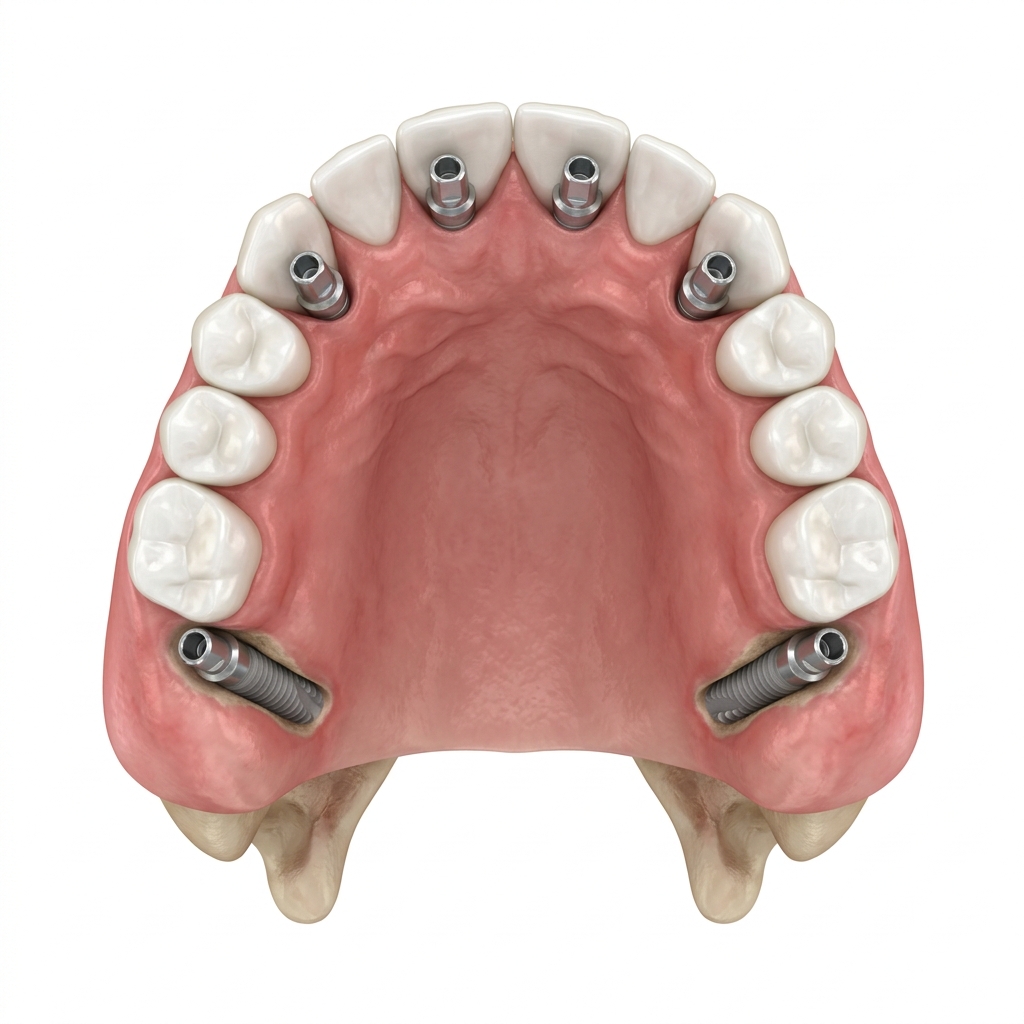
- 14 teeth per arch, including all posterior molars
- Zero fake gum: the teeth emerge from the natural gum
- Zirconia + layered ceramic, with registered trademark ®
- Custom-made: every prosthesis is a unique piece designed for the patient
Discover all the details on the dedicated page: Circolare d'Autore® — the definitive prosthesis without fake gum.