Pterygo-Zygomatic Implantology
What it is
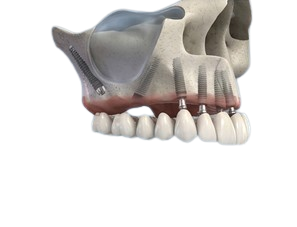
Pterygo-zygomatic implantology combines pterygoid implants anchored to the pterygoid plates of the sphenoid and zygomatic implants anchored to the zygomatic bone to rehabilitate the atrophic upper jaw, avoiding bone grafts in cases of severe atrophy using two different extra-alveolar anchorage sites.
Pterygo-zygomatic implantology is a surgical technique that combines the use of two types of long implants for the rehabilitation of the atrophic upper jaw:
- Pterygoid implants: placed in the region of the maxillary tuber and anchored to the pterygoid plates of the sphenoid, for the support of the posterior area
- Zygomatic implants: placed through the maxillary sinus and anchored to the zygomatic (malar) bone, for the support of the antero-median area
The combination of these two types of implants allows avoiding bone grafts in many cases of severe maxillary atrophy, using two different extra-alveolar anchorage sites.
Indications
The pterygo-zygomatic technique is indicated for extreme maxillary atrophy that does not allow traditional implants even with sinus lift, failure of previous implant rehabilitations with insufficient residual bone, wide and pneumatised maxillary sinuses and contraindications to bone grafts for refusal or impossibility of the patient.
- Extreme maxillary atrophy: upper maxilla with such bone loss as not to allow traditional implants even with sinus lift
- Failure of previous rehabilitations: patients with failed traditional implants and insufficient residual bone for a new conventional endosseous approach
- Maxilla with wide and pneumatised maxillary sinuses: situations where the sinus lift would be complex or risky
- Contraindications to bone grafts: patients who refuse or cannot undergo autologous bone harvesting
Procedure
The procedure involves pre-operative planning with Cone Beam CT, incision and flap elevation to expose ridge and sinus, drilling through the maxillary sinus for the placement of the 30-50 mm zygomatic implants, preparation of the site in the tuber for the 19-21 mm pterygoid implants and immediate or delayed loading based on the primary stability.
- Pre-operative planning: Cone Beam CT to evaluate the morphology of the maxillary sinus, of the zygoma and of the pterygoid plates
- Incision and elevation: full-thickness flap to expose the alveolar ridge, the lateral wall of the sinus and the region of the tuber
- Placement of the zygomatic implants: drilling through the maxillary sinus, with access to the lateral wall of the zygoma; the zygomatic implant (30-50 mm) is placed with variable inclination (classic, sinus slot or extra-sinus)
- Placement of the pterygoid implants: preparation of the site at the level of the tuber and placement of the pterygoid implant (19-21 mm) with anchorage in the sphenoid plates
- Immediate or delayed loading: based on the primary stability achieved, immediate loading is applied or 3-6 months are waited
Advantages and disadvantages
The advantages include the absence of bone grafts in selected cases and the possibility of immediate loading. The disadvantages are the high surgical complexity, the risk of chronic sinusitis because the zygomatic implants cross the sinus, the need for fake gum, the risk for nerves and vessels and the difficulty of hygiene.
Advantages
- Avoids bone grafts in selected cases
- Immediate loading possible in patients with good primary stability
- Solution for extreme atrophies
Disadvantages
- High surgical complexity
- Risk of chronic sinusitis because the zygomatic implants cross the sinus
- Need for fake gum
- Risk for nerves and vessels
- Difficulty of hygiene
Comparison with BSS
The Bilateral Sinus Solution™ (BSS) represents a more conservative alternative: it uses only basal and pterygoid endosseous implants without crossing the sinus, without sinus risk, with immediate loading always possible and a prosthesis without fake gum. The pterygo-zygomatic is indicated only in selected cases where the BSS is not applicable.
The Bilateral Sinus Solution™ (BSS) represents a more conservative alternative:
- Uses only basal endosseous and pterygoid implants without crossing the sinus
- No sinus risk
- Immediate loading always possible
- Prosthesis without fake gum
The pterygo-zygomatic is indicated only in selected cases where BSS is not applicable.
The Circolare d'Autore® prosthesis
- 14 teeth per arch, including all posterior molars
- Zero fake gum: the teeth emerge from the natural gum
- Zirconia + layered ceramic, with registered trademark ®
- Custom-made: every prosthesis is a unique piece designed for the patient
Discover all the details on the dedicated page: Circolare d'Autore® — the definitive prosthesis without fake gum.