Sinus Lift (Maxillary Sinus Lift)
What it is
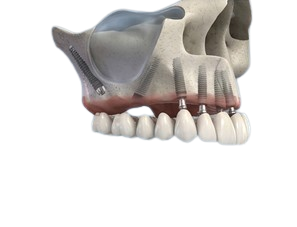
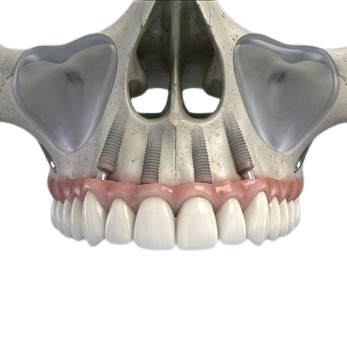
The sinus lift (maxillary sinus lift) is a reconstructive procedure that lifts the Schneiderian membrane and fills the space with graft material to increase the bone in the posterior maxilla where the sinus has pneumatised after tooth loss, allowing the subsequent placement of traditional implants.
The sinus lift (or maxillary sinus lift) is a reconstructive surgical procedure whose aim is to increase the quantity of bone in the posterior area of the upper maxilla (premolars and molars), where the maxillary sinus has expanded (pneumatised) after tooth loss, reducing the bone available for implants.
The procedure consists of lifting the Schneiderian membrane (the mucosa lining the maxillary sinus) from the lower bone wall of the sinus, creating a space that is filled with bone graft material (autologous, heterologous or synthetic). After a healing period, the newly formed bone allows the placement of traditional implants.
How it is performed
There are two techniques: the lateral sinus lift (Tatum technique) that opens a window on the sinus wall, lifts the membrane and places the graft, requiring 6-12 months of waiting; and the crestal sinus lift (Summers technique) that uses osteotomes from the crestal site to fracture the sinus floor with possible concurrent placement of the implant.
There are two main sinus lift techniques:
Lateral sinus lift (Tatum technique)
- Incision and elevation of the vestibular mucosa in the sinus area
- Osteotomy of a window on the lateral wall of the maxillary sinus with a drill or piezoelectric
- Gentle lifting of the Schneiderian membrane through the window
- Filling of the created space with graft material
- Coverage of the window with a resorbable membrane
- Waiting of 6-12 months for the maturation of the graft
- Second procedure for the placement of the implants
Crestal sinus lift (Summers technique)
- Preparation of the implant site from the alveolar ridge
- Use of increasing calibre osteotomes to fracture the sinus floor and lift the membrane
- Placement of graft material through the crestal site
- Possible concurrent placement of the implant (if the residual bone is sufficient)
Risks and complications
The main risks of the sinus lift include perforation of the Schneiderian membrane in 10-30% of cases, acute or chronic sinusitis due to infection of the graft, resorption of the grafted bone over time, exposure of the membrane due to dehiscence of the window and implant failure due to not sufficiently mature newly formed bone.
- Perforation of the Schneiderian membrane: the most common complication (10-30% of cases). A small perforation can be repaired, but if extended it can lead to the dispersion of the graft and the need to suspend the procedure
- Sinusitis: the graft can become infected, causing acute or chronic sinusitis. It requires antibiotic therapy and sometimes the removal of the graft
- Graft resorption: loss of volume of the grafted bone over time, which can compromise the stability of the implants
- Membrane exposure: the lateral window can dehisce and the membrane can expose the graft
- Implant failure: the newly formed bone may not be sufficiently mature to support the masticatory load
Healing times
The sinus lift times are very long: 6-12 months for the maturation of the graft in the lateral one, 4-6 months for the osseointegration of the implants, for a total of 10-18 months before the definitive prosthesis. The crestal one with concurrent placement can reduce but not eliminate the waiting, which remains of several months.
The sinus lift requires long times, which represent one of the main disadvantages of the procedure:
- 6-12 months for the maturation of the graft before placing the implants (in the lateral sinus lift)
- 4-6 months for the osseointegration of the implants after their placement
- Total: 10-18 months before having a functioning definitive prosthesis
Why BSS avoids the sinus lift
The Bilateral Sinus Solution™ (BSS) completely eliminates the maxillary sinus lift: the pterygoid implants anchor in the pterygoid plates of the sphenoid bypassing the sinus posteriorly, the transverse nasal implants anchor anteriorly in the premaxilla. The sinus is never touched.
The Bilateral Sinus Solution™ (BSS) completely eliminates the maxillary sinus lift:
- The pterygoid implants anchor in the pterygoid plates of the sphenoid, bypassing the sinus posteriorly
- The transverse nasal implants anchor anteriorly in the premaxilla
- The sinus is never touched: no window, no membrane lift, no graft material
- Immediate loading in 24-48 hours instead of 10-18 months of waiting
The Circolare d'Autore® prosthesis
- 14 teeth per arch, including all posterior molars
- Zero fake gum: the teeth emerge from the natural gum
- Zirconia + layered ceramic, with registered trademark ®
- Custom-made: every prosthesis is a unique piece designed for the patient
Discover all the details on the dedicated page: Circolare d'Autore® — the definitive prosthesis without fake gum.