Overdenture
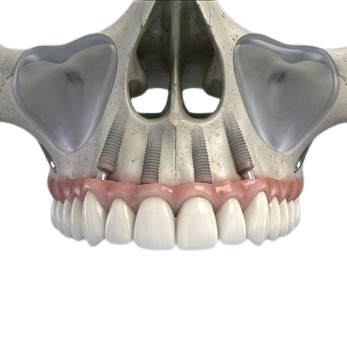
What it is
The overdenture is a removable prosthesis that attaches to 2-6 implants with press studs or bars. It offers better retention than the traditional denture but remains a removable solution: it must be removed every night and has functional limits compared to a fixed prosthesis.
The overdenture is a removable dental prosthesis that rests on osseointegrated implants. Unlike a traditional denture, which is based only on the mucosa, the overdenture uses 2-6 implants as anchorage points to improve retention and stability.
It is often proposed as a cheap solution for patients with total edentulism who cannot afford a complete fixed prosthesis. However, the removable nature involves significant functional compromises.
How it works
The overdenture attaches to the implants with O-ring press studs (cheap but with O-rings to replace every 6-12 months) or Dolder/Hader metal bars (greater stability but more expensive and bulkier). Both solutions require the prosthesis to be removed every night.
The overdenture attaches to the implants with:
- O-ring press studs: cheap but with O-rings to replace every 6-12 months
- Dolder/Hader metal bars: greater stability but more expensive and bulkier
Both solutions require the prosthesis to be removed every night.
Advantages
The advantages of the overdenture include: greater retention compared to the traditional denture, lower cost than a fixed prosthesis on implants, improved chewing and aesthetics compared to the denture, and the possibility of direct implant hygiene.
The advantages of the overdenture include:
- Greater retention compared to the traditional denture
- Lower cost compared to a fixed prosthesis on implants
- Improvement of chewing and aesthetics compared to the denture
- Possibility of direct hygiene of the implants
Disadvantages
The disadvantages of the overdenture include: removable nature with a prosthesis to remove every night, palatal bulk in the upper prosthesis, risk of base fractures, the need to replace O-rings and attachments periodically, bone atrophy still present and altered phonetics.
The disadvantages of the overdenture include:
- Removable nature with prosthesis to remove every night
- Bulkiness of the palate in the upper prosthesis
- Risk of fractures of the base
- Need to replace O-rings and attachments periodically
- Bone atrophy still present
- Altered phonetics
Comparison with fixed prosthesis
Compared to a fixed prosthesis such as the Circolare d'Autore®, the overdenture offers reduced chewing, the need for periodic attachment maintenance, night-time removal and residual bone atrophy. The fixed prosthesis on implants with basal bone definitively solves all these limits.
Compared to a fixed prosthesis such as the Circolare d'Autore®, the overdenture offers:
| Characteristic | Overdenture | Fixed prosthesis (Circolare d'Autore®) |
|---|---|---|
| Removable | Yes (every night) | No |
| Chewing | Reduced | 100% |
| Maintenance | Periodic (O-rings, bars) | Minimal |
| Bone atrophy | Residual | Prevented |
| Aesthetics | Limited (fake gum) | Natural |
The Circolare d'Autore® prosthesis
- 14 teeth per arch, including all posterior molars
- Zero fake gum: the teeth emerge from the natural gum
- Zirconia + layered ceramic, with registered trademark ®
- Custom-made: every prosthesis is a unique piece designed for the patient
Discover all the details on the dedicated page: Circolare d'Autore® — the definitive prosthesis without fake gum.