Removable Dental Prosthesis and Denture
Introduction
The removable dental prosthesis (denture) is the most traditional solution to replace missing teeth. Made of acrylic resin, it rests only on the mucosa without stable anchorage, strongly limiting the masticatory performance and causing progressive bone atrophy.
The removable dental prosthesis, commonly called denture, is a prosthesis that the patient can insert and remove autonomously. It is the most traditional solution for the replacement of missing teeth, but it presents significant functional, aesthetic and biological limits.
Made of acrylic resin (PMMA) with resin or composite teeth, the denture rests exclusively on the oral mucosa and on the underlying bone. Unlike prostheses on implants, it has no stable anchorage and this strongly limits its performance.
Complete denture
The complete denture replaces all the teeth of an arch resting only on the mucosa. Its retention depends on adhesion and negative pressure, with great variability between patients. In cases of severe atrophy the retention is strongly compromised, making the denture almost unusable.
The complete denture replaces all the teeth of an arch resting only on the mucosa. Its retention depends on adhesion and negative pressure, with great variability between patients. In cases of severe atrophy the retention is strongly compromised, making the denture almost unusable.
Partial denture
The partial denture replaces some missing teeth and hooks onto the remaining teeth with metal clasps. The visible clasps compromise the aesthetics, while the pressure on the abutment teeth can cause mobility and periodontal damage over time.
The partial denture replaces some missing teeth and hooks onto the remaining teeth with metal clasps. The visible clasps compromise the aesthetics, while the pressure on the abutment teeth can cause mobility and periodontal damage over time.
Stability
The stability of a denture is linked exclusively to the contact with the mucosa and to the negative pressure. Factors such as speaking, coughing or laughing can cause the detachment of the prosthesis. The stability progressively worsens with the bone resorption, making frequent relining necessary.
The stability of a denture is linked exclusively to the contact with the mucosa and to the negative pressure. Factors such as speaking, coughing or laughing can cause the detachment of the prosthesis. The stability progressively worsens with the bone resorption, making frequent relining necessary.
Reduced chewing
The denture reduces the masticatory capacity by up to 70% compared to the natural dentition. The force exerted is considerably lower and the patient tends to avoid hard or fibrous foods. Over time the limited chewing leads to unbalanced diets and digestive problems.
The denture reduces the masticatory capacity by up to 70% compared to the natural dentition. The force exerted is considerably lower and the patient tends to avoid hard or fibrous foods. Over time the limited chewing leads to unbalanced diets and digestive problems.
Retention problems
The retention of the denture depends on the shape of the ridge and on the quality of the mucosa. A flat ridge or a thin mucosa drastically reduce the retention. The use of adhesives (prosthesis glue) is a palliative that does not solve the underlying problem.
The retention of the denture depends on the shape of the ridge and on the quality of the mucosa. A flat ridge or a thin mucosa drastically reduce the retention. The use of adhesives (prosthesis glue) is a palliative that does not solve the underlying problem.
Aesthetics
The denture has a limited aesthetics: teeth of artificial appearance, visible pink fake gum, loss of lip support with aged appearance and phonetic limitations. Many patients feel uncomfortable smiling and speaking in public.
The denture has a limited aesthetics: teeth of artificial appearance, visible pink fake gum, loss of lip support with aged appearance and phonetic limitations. Many patients feel uncomfortable smiling and speaking in public.
Comparison with fixed prosthesis on implants
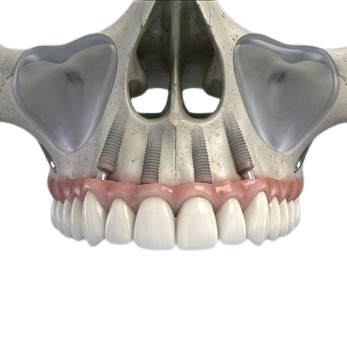
Compared to a fixed prosthesis on implants (such as the Circolare d'Autore®), the denture offers 70% reduced chewing, no functional stability, progressive bone atrophy, retention problems, mediocre aesthetics and the need for relining and replacement every 5-7 years. The fixed prosthesis on implants with basal bone definitively solves all these problems.
Compared to a fixed prosthesis on implants (such as the Circolare d'Autore®), the denture offers:
| Characteristic | Denture | Fixed prosthesis on implants |
|---|---|---|
| Chewing | Reduced by 70% | 100% |
| Stability | Absent | Total |
| Bone resorption | Progressive | Prevented |
| Retention | Problems | Fixed with screws |
| Aesthetics | Mediocre | Natural |
| Replacement | Every 5-7 years | Never |
The fixed prosthesis on implants with basal bone definitively solves all these problems. Discover the Bilateral Sinus Solution™ (BSS).
The Circolare d'Autore® prosthesis
- 14 teeth per arch, including all posterior molars
- Zero fake gum: the teeth emerge from the natural gum
- Zirconia + layered ceramic, with registered trademark ®
- Custom-made: every prosthesis is a unique piece designed for the patient
Discover all the details on the dedicated page: Circolare d'Autore® — the definitive prosthesis without fake gum.